
Who Am I Now? Grappling with Identity in Motherhood
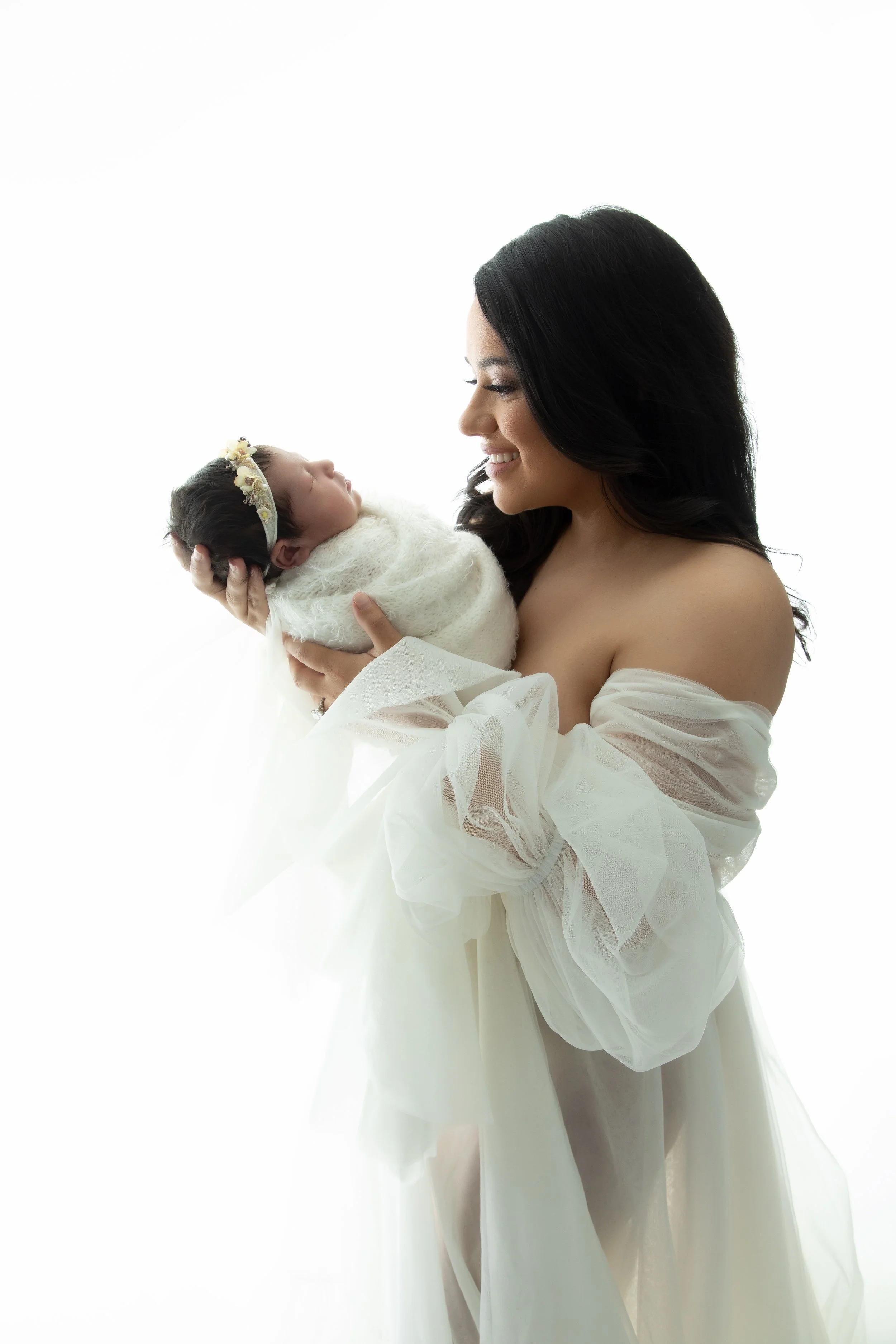
I remember it was a week after I gave birth that I had this distinct thought…who am I? I knew that I was the freshly minted mother to Isa, I was a wife, I was by all accounts the same Ally that had walked in to the Labor and Delivery Department just ten days before except I was not. It was like having this fresh new human that belonged to me had completely erased the foundation of who I was. And maybe it was just me, but I felt a little lost. One could say that I was having a full on existential crisis in the midst of early motherhood. Maybe it was the exhaustion from baby girl sleeping only two or three hours at a time but nothing could have prepared me for this hole that I felt in my identity - that’s the best way I can think to describe it.
I looked up identity and motherhood in Google and to my surprise this phenomenon that I was experiencing actually had a name, something I had not heard before, matrescence. According to the Cambridge dictionary and the Perinatal Mental Health Center of Chicago, matrescence is the process of becoming a mother, including the physical, emotional, psychological, and social changes that come with that transition. Dana Raphael was an anthropologist who coined the term in the 1970s. She defined that it is the developmental transformation in motherhood, much like adolescence is a transition into adulthood. Landing on the definition made me feel less alone and like other moms before me had also had to come to terms with this new identity and aspect of their development into motherhood. I was also very intrigued to find out that there were actual physical changes in the brain that occurred as a result of matrescence. There is a major neuroplastic shift that happens in the brain during pregnancy and early postpartum. But what do these changes actually mean for us as moms? These changes are thought to help the brain adapt to caregiving and in particular a pruning where less-used brain connections are reduced and more efficient and relevant networks are strengthened. In essence, our brains become more effectively adapted for motherhood. Since we understand the definition and brain science of matrescence a little better let’s talk a little about what this identity shift actually meant in my life.
Like I mentioned earlier, in the early postpartum days I felt lost honestly. It felt like a big part of me was gone and now I was just this shell of a person whose top priority was keeping my baby safe. If I’m being honest I felt like a zombie, like it was me having the thoughts in my head but there was something so unfamiliar and frankly unreal about everything I was experiencing. Looking back, I think my first days as a new mom were strongly colored by my birthing experience, while I was not diagnosed officially then, I was probably suffering from some sort of PTSD. As every day passed, I got more and more attuned with what my baby needed, I got more used to my physical body, and I got the hang of being a mom. But it did not happen overnight. Now that I am almost 22 months postpartum, I can say that I am much more in tune with who I am as a mother and as a person. However, this did not happen from one day, week, or month to the next. It was a process that entailed extensive self reflection, journaling, therapy, and an assessment of who I was. In some ways, this journey has made me get back to myself, and realize that I am still her and now more her as a result of this. This process has not been easy and has required a lot of time energy and attention. I have made it a point to go to therapy, to journal, and to spend intentional time with myself to so I can figure out who I am at this stage. I’ve asked myself so many questions and engaged in many thought exercises.
I’ve had to ask myself the following questions:
What makes me happy?
What do I enjoy?
What parts of myself are central to my identity?
What parts are negotiable?
What kind of mother do I want to be?
How am I showing up for myself?
How am I building time for myself on a daily basis?
What practices help me feel grounded in my identity?
What routines and systems help me feel more like myself?
Am I making myself a priority?
How am I preventing burn out?
How do I ask for help?
Am I keeping the promises I make to myself?
My experience grappling with my identity as a new mom was hard and that’s just how I experienced it. If this was not the case for you, that is awesome. If you also had a tough time, I hope you know that that is perfectly okay. We are never taught about these things and we just have to figure it out. If you are still on the road to figuring out your new identity in motherhood, I hope you know that we all are.